The focus for Revenue Operations is aligning and optimizing revenue-generating functions to achieve business objectives. This strategic function helps align and optimize the activities of sales, marketing, and customer success teams to drive revenue growth.
https://revenuearchitects.com/wp-content/uploads/2024/04/shutterstock_1556057936-scaled.jpg15362560John Stonehttps://www.revenuearchitects.com/wp-content/uploads/2013/08/RA_logo-300x137.pngJohn Stone2024-04-07 16:04:002024-04-08 08:49:35The Essence of RevOps and its Role in Driving Business Growth
More insights for the 85% of B2B marketers who don’t have effective personas!
Mapping out your buyers’ pain and organizing via Pain Maps™ to enable the ULTIMATE Goal: Informing Engagement Personas™.
There are many different perspectives and philosophies on persona development. This makes sense, as they’re the most critical element of creating messaging and informing Message Maps™…then identifying and developing content aligned with the buy cycle…and ultimately validating the various components of a true buyer engagement strategy. In the end, persona development should be defined by how it’ll be used – in terms of purposeand context that will drive messaging, and ultimately content strategy. Other marketers will use it more as a “playbook” of all possible or available buyer insights. I’m not saying either is right or wrong, but it’s why we’ve created a new category called Engagement Personas™.
https://revenuearchitects.com/wp-content/uploads/2018/05/Underwater-Explorer1.jpg400698John Stonehttps://www.revenuearchitects.com/wp-content/uploads/2013/08/RA_logo-300x137.pngJohn Stone2020-05-30 10:32:182024-04-07 09:33:17Solving The Persona and Product Marketing Paradox: Engagement Personas
Consider Revenue Architecture When Selecting Your Tech Stack
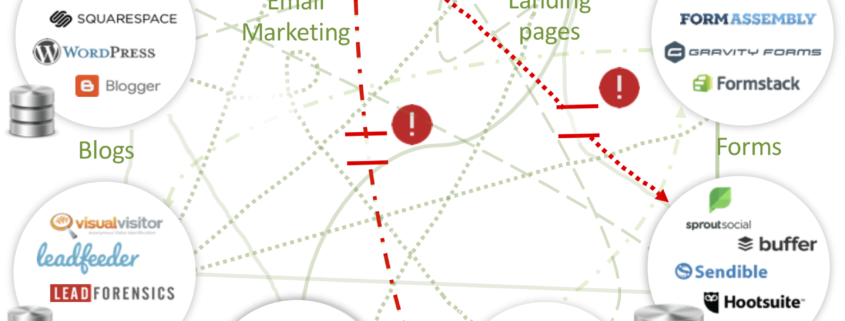
Face it, buyers don’t care whether they are interacting with your marketing or your sales organization, they follow their buying process – often in an unstructured and unpredictable way. They self-sell on the web, research with influencers, and engage 1:1 with salespeople. An effective buyer experience across a dynamic buyer’s lifecycle requires that your revenue architecture is designed with a coordinated closed-loop process supported by an integrated technology stack.
We read a lot about Martech and SalesTech stacks. This is understandable because marketing and sales teams have traditionally pursued distinct missions with different needs. Yet if your marketing, sales, and service “front office” needs to be more integrated to support dynamic buyer pathways, you might need to re-think your technology stack. An integrated revenue process supported by integrated revenue technology helps deliver a single view of the customer and becomes more responsive and relevant as your buyers jig and jag along their dynamic buying processes.
The buy-sell process for B2B high consideration products and services is complex and highly collaborative involving team selling to committee buying. Virtual workspaces like Smart Rooms from Journey Sales facilitate this process by helping account teams share, collaborate and communicate with buying teams throughout dynamic sales and onboarding lifecycles.
Journey Sales built Smart Rooms natively on Salesforce® as digital workspaces that allow sales teams and service teams to quickly create personalized, guided digital experiences with their account buyers and track engagement along the way.
To optimize B2B sales, we often design funnels to drive out metrics and codify sales processes. Linear funnels for B2B are particularly relevant when purchasing is transactional or follows a highly predictable process. Yet, for complex B2B and high consideration sales, customers are interacting with a range of 3rd party research, journals and publications, as well as your competitor’s funnel. This is why we need a non-linear more collaborative approach to selling and engaging the client – one that allows us to build our value propositions responsively and engage customer teams over time. For these more complex sales and dynamic environments, a Smart Room is a great fit.
Traditionally, marketing teams generate leads, while sales teams close deals. With the web and the shift of the customer buying process and business-to-customer interactions, the lines between marketing and sales are blurred. Companies today know that they need to adapt, but how?
Growth-focused companies often wrestle with aligning marketing and sales to maximize revenue growth. A key goal is establishing a “service level agreement” between marketing and sales teams that defines both the required quantity and the characteristics of the ‘MQL” or Marketing Qualified Lead”. But there is more to it then that. Marketing and sales teams today, must work together to orchestrate the customer experience end-to-end and generate leads, nurture opportunities in the pipeline and ultimately convert sales. And, they need to track this end-to-end so they can attribute revenue to marketing programs and campaigns and see what is working and not working.
A useful framework to manage this end-to-end process is the “Closed Loop Marketing Architecture”.
If your company were a living creature, Sales and Marketing would be two specialized vital organs that need to work together to sustain and grow your business. Lack of communication or coordination in these essential areas can hinder your company’s growth or even cause it to wither. To work effectively they need an integrated and streamlined process to keep your company healthy.
Closed Loop Marketing Architecture™
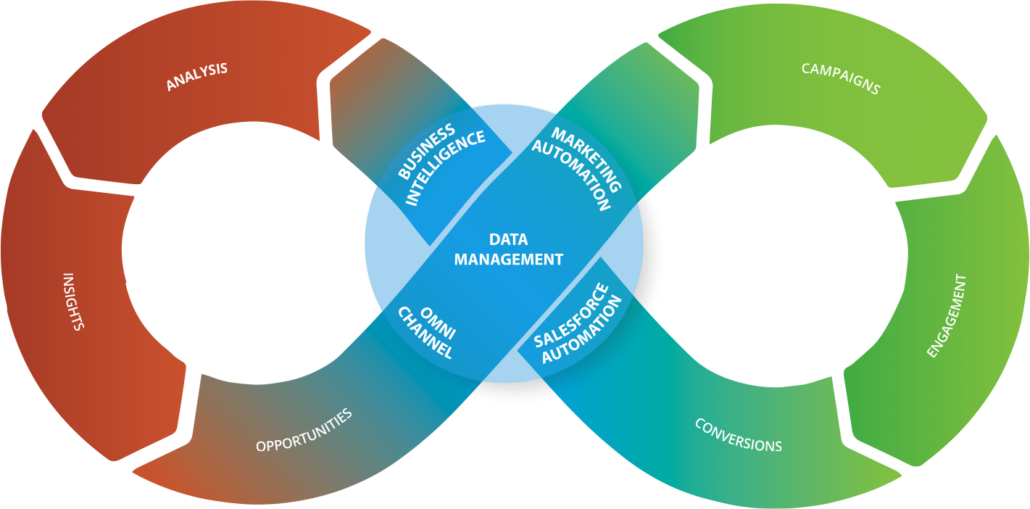
At Revenue Architects, we’ve developed a Closed Loop Marketing Architecture™ to provide a blueprint for revenue marketing and aligning marketing and sales. It’s a continuous process that delivers tailored omni-channel experiences that engage customers and drive conversions. By ‘closing the loop’, sales and marketing align around the end-to-end customer lifecycle and campaigns are measured for total revenue impact.
This blueprint enables businesses to refine their marketing strategies based on data that is managed and analyzed to provide much needed insights into your prospects and the customer lifecycle. Many businesses perform these same tasks internally with various teams, or pay for multiple services — like e-blast platforms, CRMs, lead tracking, etc. — but often these methods, which don’t ‘close the loop’, waste valuable resources and lead to incomplete or ineffective results.
It’s the middle of Q4 and the end of the year is fast-approaching. For many, it is a time to slow down from work and spend time with family. For sales people, it’s can be a frantic time, as many B2B companies must close sales opportunities to achieve revenue goals.
So, what can the marketing team do to help the sales team and ring in the New Year on a positive note? Here are a few tips to align marketing and sales and help ease the December frenzy and drive some upward momentum into the New Year.
https://www.revenuearchitects.com/wp-content/uploads/2013/08/RA_logo-300x137.png00nhillhttps://www.revenuearchitects.com/wp-content/uploads/2013/08/RA_logo-300x137.pngnhill2015-11-06 13:29:422017-01-26 10:58:24Align Marketing and Sales to End 2015 Strong
Imagine a marketing and sales team working in perfect harmony, seamlessly passing qualified leads from one department to the next. This ideal scenario is made possible through the Closed Loop Marketing Architecture (CLMA), a data-driven approach that aligns teams, optimizes processes and drives revenue growth.
Marketing Automation has been around since the 1990s. Back then, the focus was on automating email marketing— managing the development and delivery of emails to target lists at scheduled times. Over the decades, software developers expanded the capabilities of Marketing Automation to meet the requirements of a variety of marketing functions and users.
Today, Marketing Automation refers to a broad range software technology for marketing and it is an important element of closed loop marketing. Its evolution has raised many questions about what it is, what it does, and whom it benefits.
Corporations with complex, high-consideration sales are often accused of focusing on the short-term, which is inevitably reflected in their demand generation or campaign strategy. This generally means that marketing and sales are not aligned and operating to some degree as silos. With short-term horizons, the campaign communications focus tends to be on sales driven, tactical programs designed to seek out “hot leads”.
In the highly competitive, complex B2B sales world with longer sales cycles, this is not fully sustainable. There is a typically a sales team or committees of savvy buyers. A short term focus may eke out some leads, but what about the other leads who may with some nurturing turn out to be qualified opportunities — but not yet “sales-ready.” The modern buyer knows your product or service from what is readily available on the web and related sources and will be considering any number of options before making a decision.
Studies show that 50% of leads are qualified but aren’t immediately ready to buy something from you [Source: Gleanster Research]. With lead nurturing however, you can bring those leads through your sales funnel and garner 4-10 times the response rate compared to a regular email blast while doing it [Source: SilverPop/DemandGen Report].