Revenue growth focused posts

If you are using Rapportive or Gist or Xobni, you know what I mean. At the tip of your fingertips, you now can see the online profile and presence of the contacts you are engaging with day-to-day on email.

We often say “have you Googled yourself?” and it is a good question because so much of our personal lives are displayed on the web. Of course, with search, one must take a proactive step to search for me … with Rapportive, the information is displayed automatically when I open an email or type an email address. At a glance, I can get a sense of whether you are a crazy, a connoisseur or a content expert.

I am working on a project with one of our expert network consultants, Laurent ( @opinionwatch ), and he suggested I try Rapportive in my Gmail (Google Apps) account. I had used Xobni with Outlook, but I switched to the cloud completely a few months back (and have not looked back.)

Social intelligence tools are useful and quite revealing. There are exciting new tools coming down the pike – including my colleague’s company Data Hug that promises to intelligently mine relationships from email. Give these tools a try and definitely Rapportive-ize yourself –  and see how you shape up in this increasingly transparent social web.

This article was posted on www.revenizer.com. Revenizer is an affiliate business to Revenue Architects focused on building useful business applications that support revenue acceleration.

Revenue growth requires focus.

Today, there are almost unlimited sources of data and opportunities to invest time in complex analysis. For most businesses, analysis can suck in time but have little business impact. Is an hour spent by a business owner exploring Google Analytics to uncover that she has a customer in Russia useful? Does using a social analytics package to discover that 60% of users are female (based on an algorithm that analyses names) drive a business forward. Probably not.

The Bugatti Veyron is a $2.4 million piece of technology. It can reach 253 miles per hour. There is no shortage of data that could be presented to the driver. There is only one thing that matters given that the objective is to accelerate as fast as possible. Engine revs – because this metric is the leading indicator for speed and also communicates engine damage risk potential. The rev counter is the center gauge on the console. In an environment where time and attention is limited, this is the driver’s main focus.

Businesses need to have the same laser focus on leading indicators. Social media may not directly create leads but it shows an ability to create community around an idea. The essence of a brand. Web traffic means nothing unless it converts but generally increasing traffic will lead to good things.

The big lesson – metrics are about communication not analysis. Communication makes people accountable, gives direction and motivates. The rev counter in the Bugatti makes the driver accountable for engine damage, tells her when to change gear and gives her a clear target range. This focus means 0 to 210 miles per hour in 27 seconds.

Are you focused on a few leading indicators that matter and motivate?

The recently published CMO survey (link:  https://www.cmosurvey.org/blog/marketing-metrics-what-cmos-report/ ) is quite timely for our team at Revenue Architects. The survey indicates both the growing importance of key revenue metrics and the relatively poor and inconsistent adoption of the right metrics as indicators of revenue performance. While no two businesses are exactly alike, there are a number of key metrics that are leading indicators of future revenue performance.

Last week Revenizer was formed as a new company to deliver a performance-oriented revenue scorecard and collaborative tool for executives. Revenue Architects’ Phil Rogers and our colleague, Satish Boppana, and I formed Revenizer to build and deliver a new generation revenue performance scoreboard and collaborative platform. Betaspring in Providence, RI is backing the project with their industry leading accelerator program.

The vision is to help revenue executives create a growth and revenue culture.

As we talk about all the time at Revenue Architects, sales, marketing and service must work together in a more joined-up and collaborative process for revenue. The days of separate and non-aligned sales and marketing organizations are giving way to a more unified revenue value chain. The disruptive forces of digital and inbound marketing and social media in the buy-sell process is accelerating this trend.

Revenizer will integrate leading web apps from social to CRM to give business leaders one place to go for the key revenue indicators needed to manage performance. It will also provide best practices and expert and user collaborative content to guide teams on revenue performance improvement strategies. With Revenizer, a business can better execute its revenue strategy with greater transparency, focus, organization and knowledge  – accelerating revenue growth.

If you want to join the beta team of users and help shape this exciting solution, please contact us!


We are in the midst of selecting a social monitoring and engagement platform for one of our client’s social programs. The client is starting from scratch to establish an effective social presence, build a following and engage their audience. They have the opportunity to be a content leader in their market.

We won’t even scratch the surface on the full analysis in this post, but the headline is: Chose carefully, test first and don’t lock in. There are a lot of changes in this space including acquisitions and consolidations and different tools are likely going to be needed for different purposes – from engagement to sentiment analysis and influencer tracking.

We know that the client will need a solid social monitoring and engagement platform over time and there are new entrants every day to join early platforms like Radian6. We have taken a look at Sysomos, Spredfast, Radian6, HootSuite, CoTweet, and Traackr among a few others. Amazingly, we are getting very poor results with some of the tools where our search terms are not returning meaningful results. Some of the tools are far better suited for broad-based brand listening rather than focused subject influence.

Trigger-based emails, rules-based emails, real-time emails, or auto-responder emails are great tools for today’s marketers. Regardless of what you call it, these are the emails we receive as customers after doing something or buying something. We get order confirmations, email reminders, survey invitations, e-newsletter subscriptions and product cross-sell promotions. As an online customers , my inbox is bombarded. Some of them are relevant and timely and catch my attention, others I ignore and then eventually unsubscribe.

A “promise” of trigger-based emails is that you can “set it and forget it.” However, there are several variables in email marketing that can always be tested and optimized. Some examples are the subject line, preheaders, design, layout, copy, calls to action, timing, message/offer, etc. Given this, how can a trigger-based campaign be truly set and forgotten about?

I think some companies have forgotten about me. At some point, ignoring emails leads to annoyance and opt-outs. We have advised clients to look at bounces, open rates, and click-through rates to develop rules to purge non-responders, or move them to a campaign with fewer communications. While trigger-based emails are automated, they require the human brain to set them up for success. The last thing businesses need, especially in B2B, is customer fatigue and  a shrinking opt-in email list they worked so hard to develop.

The arrival of ecommerce and other web technologies created a lot of talk about the leveling of the playing field between small / mid-sized businesses and large business. For a while, there was some truth to this. Today, scale and size are back in town. Big and well resourced firms can again spend their way to success supporting multi-channel, content-driven campaigns.

Channels

What started with a web site with some site analytics then advertising is now video, Facebook, Twitter, email, etc, etc, etc. Each channel has its own subtleties and each are rapidly evolving as all the players try to own the future. For the average small or mid-sized business – life in the fast lane is tough. Dizzying is probably the right word.

Content

Participating is a start but you are only really going to engage your target audience if you have some interesting to say. Not sure how many thought leaders there are in your business but inspiration is sometimes tough to find. Making sure the invoice goes out right gets the priority. Even collecting and distributing other people’s creative genius is hard work. How much credit do you really get for retweeting?

Support technology

This is a lot to manage. Staying on top of marketing automation, web analytics and social media monitoring tools etc, etc, etc is tough. Startups with great tools keep turning up but they are often focused on making their money by working with big companies so good luck getting a reply to your email. Otherwise, they are so busy developing their product that they don’t have time to actually sell it. So again, good luck getting a reply to your email. You can try signing up for a trial. Unfortunately, most providers have not taken the lessons of companies like 37 Signals. The monthly fee might be small but you have to donate half of one person’s week to figure out how to make it work. Multiple that by X for every platform that you want / need to try.

So…. What to do?

Don’t give up

Stay involved. Things will improve. Applications will get simpler. New solutions will emerge. Stake your claim on every new thing so you don’t have to come up with some convoluted user name / handle in the future.

Campaign in a box

A campaign in a box is coming. The obvious market opportunity is to wrap services around some good low cost technology applications to give small and mid-sized businesses what they need to compete. No learning curve, help with content and social media management in partnership with your existing team. More to come from us on this. We think that it is time to level the playing field (again).

At the Schwab Advisor Services meeting in New York yesterday, about 40 advisors joined to discuss a broad vision for achieving a digital presence with social media. In describing the “how to” I shared ways of thinking about digital presence and the role of social media. To help describe ways to get started, I outlined strategies that included actions for revenue strategy, revenue systems and revenue programs. But even this breakdown of strategy and planning recommendations are a lot to tackle for a busy advisor getting started with social media. I often get the question – “OK, but what are the top three things you suggest? Here are three things I would start with to get established online:

1) Solid Website – all roads lead back here, so make sure you have a foundation you are pleased with and relevant content as well as the ability to engage your audience to download items and register for interactions.

  • Clean professionally branded
  • Relevant content
  • Conversion capabilities

2) Professional LinkedIn Profiles – This is the easiest to manage from a compliance point of view and it is very well aligned with the advisor business of referrals and relationships.

  • Keyword aligned, current, descriptive profile and business page
  • Professional photo
  • Active network and # of connections

3) Active Content Sharing – With these two platforms in place, a steady stream of relevant publishing will help place you in the minds of your audience as knowledgeable and help reinforce your credibility when it is time to make a decision.

  • Sharing relevant material, text
  • Use video if you can to explain and introduce your firm (host on YouTube)
  • Publish regularly using a blog format with an RSS feed

I am writing this post from the Acela train heading back to Boston after an interactive session with about 40 clients of Schwab Advisor Services in New York. One discussion at the event was with Adam Sheer from the Roosevelt Investment Group which was particularly interesting and I think offers some guidance when thinking about strategies for using Twitter and what content to share across social nets.

The Roosevelt Investment Group prides itself on always adding value in their interactions with clients. These interactions, today, use email or other 1:1 communication. So, when considering using a platform like Twitter, what should their approach be? What content should they tweet and share? An example I shared in my presentation was about ReTweeting a “good news” post from a client relationship as a way to help build the relationship. However, since the Tweet may have no direct relevance to investment management, would it be of any interest to the followers of the firm? The answer depends on the strategy employed and the role of your Twitter ID. What do you want to be known for on Twitter? Are you building a network of people and tweeting on multiple topics or only on business topics? After all, we know that Twitter is not just a business network…and the choice is yours.

So what is the lesson?

Yes, you can mix personal and business tweets – but begin by thinking about the role of your Twitter channel. Do you want a range of personal communications or a feed of posts about specific content themes? Perhaps you should consider multiple Twitter IDs – personal and business. Is your Twitter feed going to be about multiple topics, or focused on a specific audience?

Among wealth managers/ financial advisers, there remains skepticism about using social media and a digital marketing with a stronger online presence. As I prepare for an updated “Day-in-the-life of an adviser” talk next week with Schwab RIAs (clients of Schwab Advisor Services), I created a summary slide to serve as an abstract for the talk. The slide sums up the key messages for me:

  • While digital marketing will not and should not replace personal 1:1 relationship strategies, it can help you grow your practice and deepen existing relationships – particularly among your increasingly connected client base.
  • A good online presence can help you shift your business mix from traditional “outbound” activity to “inbound” – lowering cost of client acquisition.
  • But, as content proliferates, clients will increasingly use “relevance filters” – using search, influencers and their human “social networks” for trusted answers. It is hard to “game the system”
  • And, for advisors, regulation and changing technology add risk and confusion.
  • So, what should you do?
  • Today more than ever, firms need an effective digital marketing strategy and plan that aligns with their target client strategy.

The follow-on question is what makes up that strategy?

We focus on the three elements of the Revenue Architecture – keeping it simple, breaking it down:

1 Revenue Strategy

  • Set your ambition
  • Segment your audience & define long-tail positions
  • Build value propositions
  • Measure capability and gaps
  • Envision creative strategies

2 Revenue Systems

  • Design a solid website for brand experience
  • Configure and deploy foundation technology / services for digital marketing
  • Establish digital/social outposts

3 Revenue Programs

  • Design creative multi-touch campaigns
  • Develop a month-to-month/ week to week calendar
  • Create multi-media content
  • Publish and engage

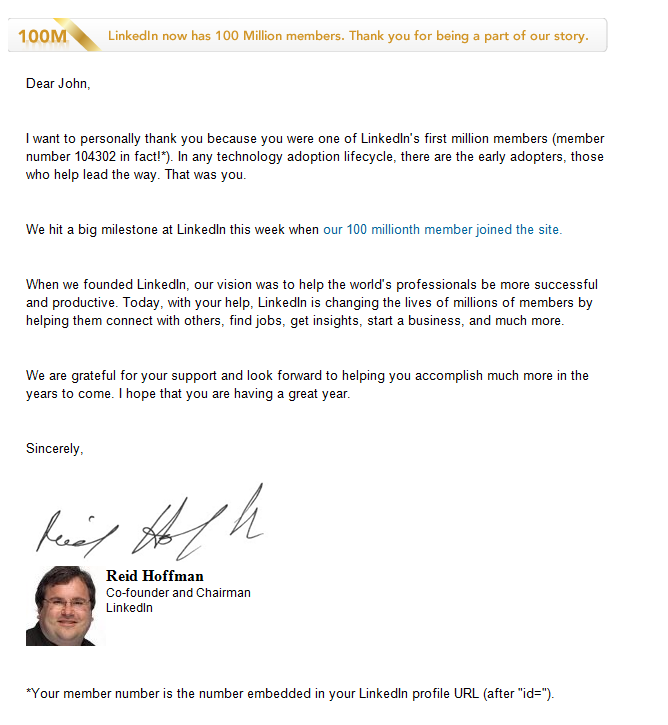
Today I received this nice letter from Reid Hoffman recognizing me for being an early adopter. Too bad I wasn’t an early investor!! I remember while at PA Consulting Group in 2003, I wrote an article and started working with clients around the concept of using “relationship intelligence” for business (sales) advantage. The ideas stemmed in part from my excitement over the early stage company and service called ” LinkedIn” and my work building digital businesses at Viant. I have been a user ever since.

Here is the letter I received today.. I guess I was user number 104,302 on LinkedIn and now they have reached the 100M user mark.
LinkedIn100M

Fast forward. Today we work with relationship-centric clients like Blackrock, Putnam, MFS, HighMark Funds and Wasatch Funds, ConRes, The First Group along with a range of mid-market clients, financial advisors and RIAs to develop personalized revenue strategies that use social media.

Why do we social tools are so valuable for business?

To me it boils down to TRUST and TIME. With so many people jumping on board and in many cases “gaming” the SEO system with content marketing strategies, buyers like you and me increasingly rely on our HUMAN network to get our answers. Our human network IS our social network. Our social network is our business network, we buy from people we know and trust.

Two recent examples:

Just yesterday, I networked in and met with my former colleague, Pierre Loic Assayag, at Traackr and gained lots of good advice on potential partners, tools and systems. He also shared with how the culture in California – where they are moving – is very much about human social network that drives business success. Perhaps we in Boston-Cambridge need to learn a lesson here and get out into the cold and network more so we can keep up. I trust Pierre to give me good input. Nothing has changed. What has changes is that I can in seconds search my LinkedIn network for people I know that can help our business.

A month ago, I was going to share Emily Guertin’s LinkedIn profile with a business colleague… but the profile did not say “Registered Dietitian” so I had her add that in. Within a week, she was contacted by another former Viant colleague and offered a fantastic new position. The hiring manager was looking for a “Registered Dietitian” within his personal LinkedIn network. She was right there. Now, Emily, there is a lot more you still need to do on your profile, so let’s talk. 🙂

Soon we will be starting with our human network first and using tools like LinkedIn and other social and business networks to support most every business and personal buying decision. I know I already do. Perhaps it is time I dust off and re-launch one of our projects – Goodasitgets – the social ranking system to support buying experiences. Thanks, LinkedIn for making a good product and also for reminding us how impactful social media has become.