
Solution
RAOS: your revenue operating system
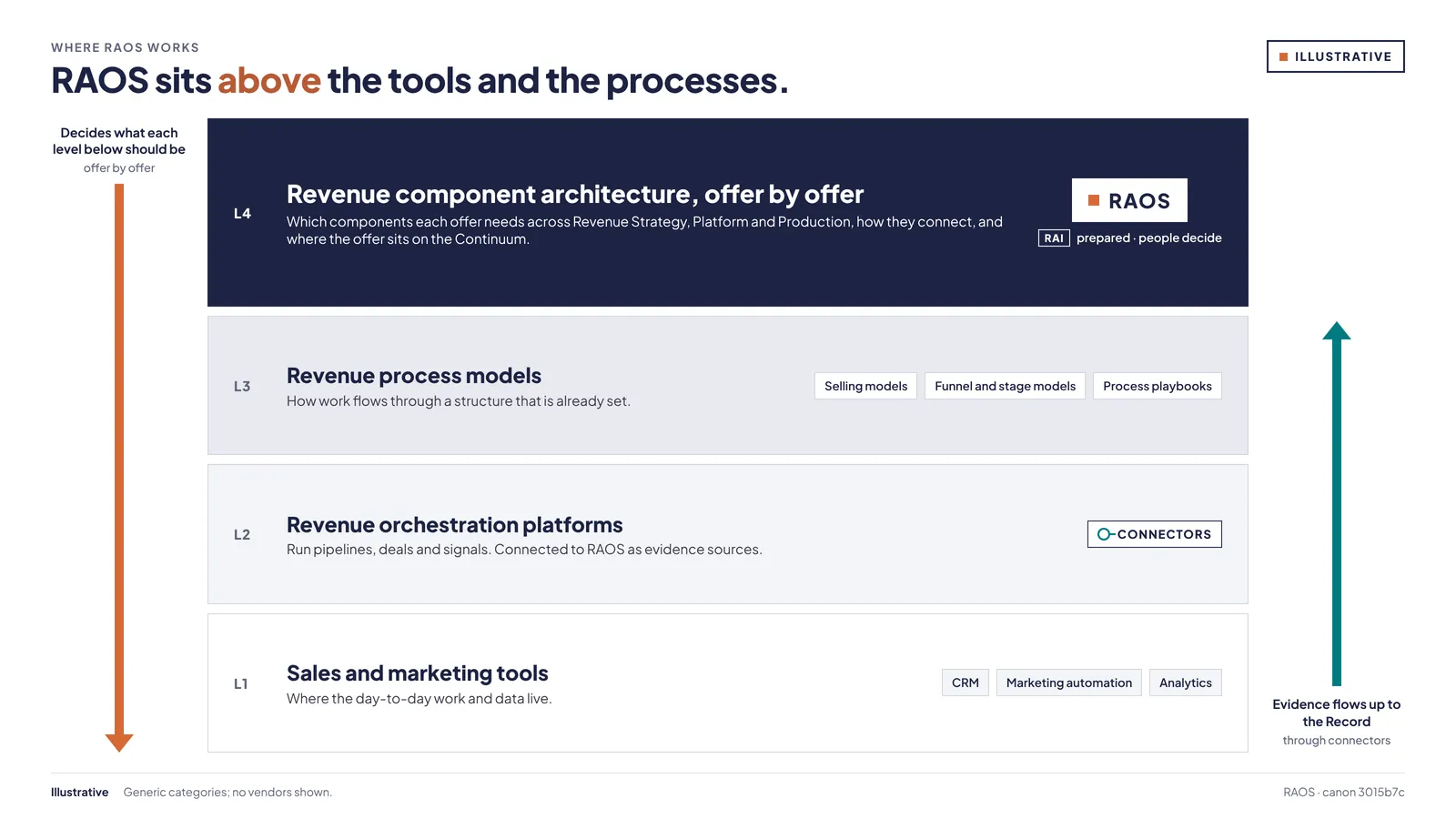
RAOS is Revenue Architecture in action: the strategic lens your company runs its revenue on, sitting above the tools you already use.
RAOS isn’t software. It’s the architecture, the method and the intelligence that keep it current.
RAOS
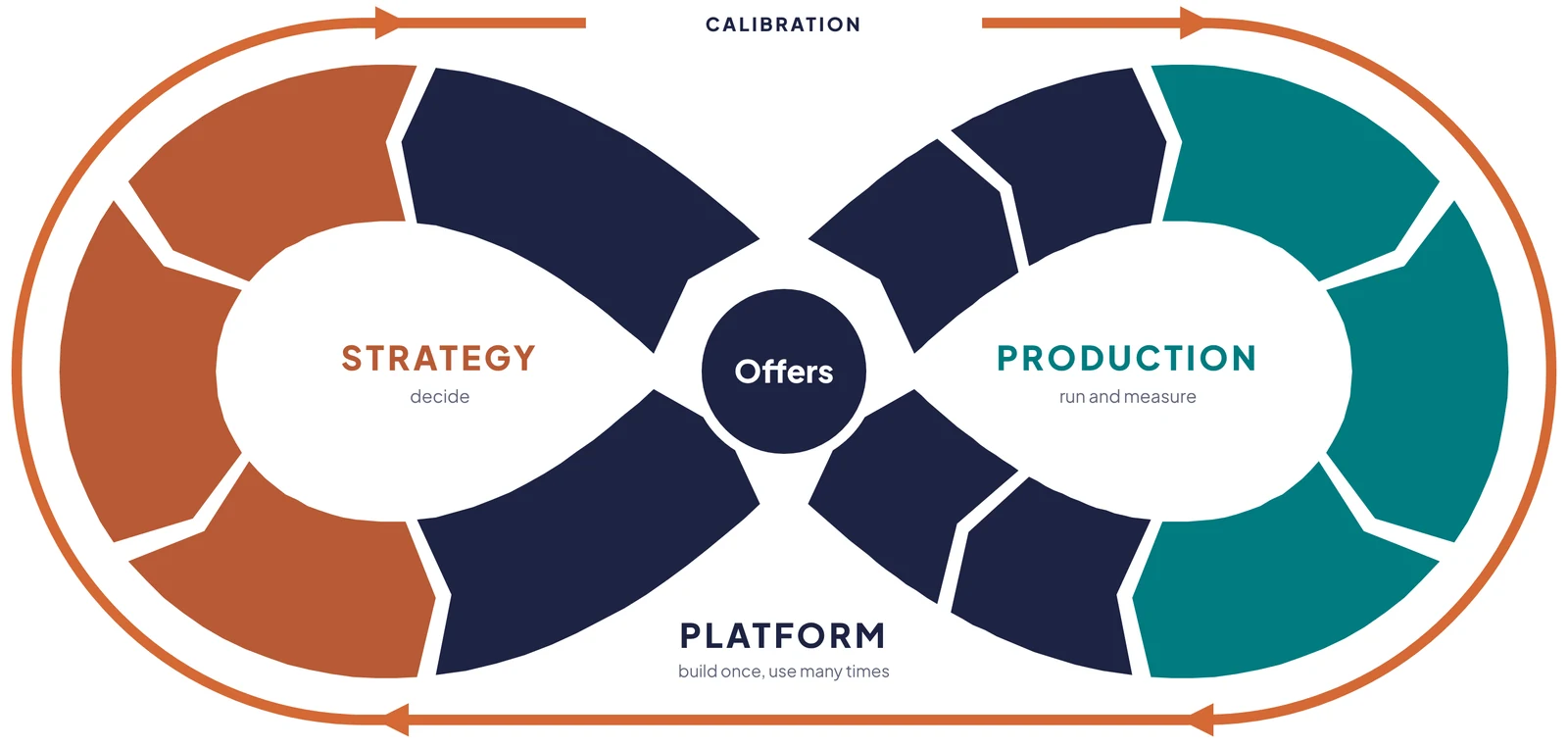
A closed-loop revenue system
Five parts: Continuum · Model · Calibration · Connections · RAI.
-
Continuum
Where each offer sits.
RAOS places each offer by what carries the value the buyer pays for, and who is accountable for it: Expertise, Service, Automated Service, Product or Network. It applies offer by offer, never to the firm, and it isn’t a ranking.
The five positions → -
Model
What revenue runs on.
Twenty-three components across Strategy, Platform and Production, grouped into six build units. Each offer sits at the center, tagged with its Continuum position, which sets what “right” looks like for its components.
See the Model → -
Calibration
How it stays right.
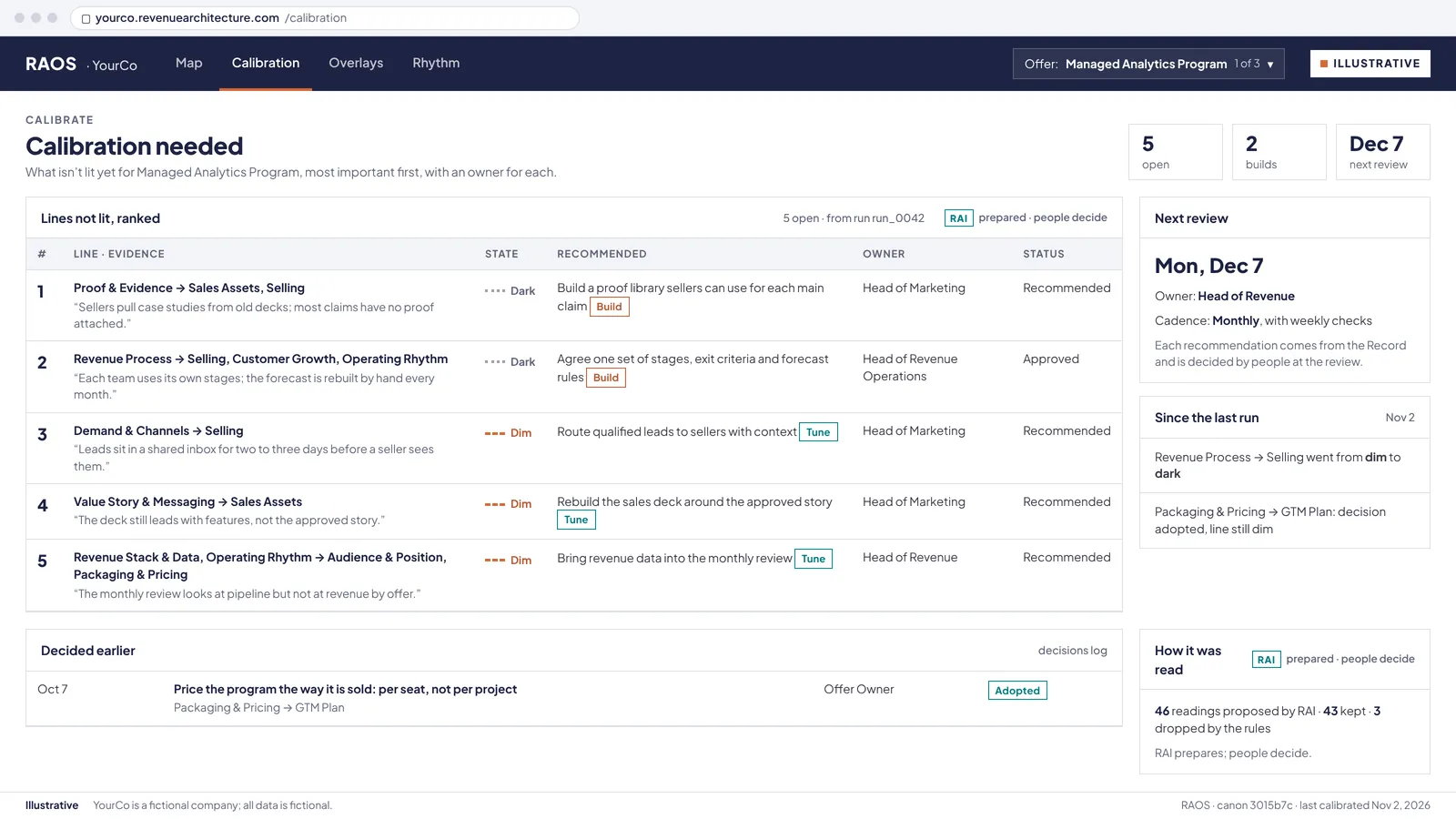
The loop around the Model. RAOS tests each offer against its Continuum position and the evidence, and every review ends in a call: shift, tune or no change needed. The cadence is set offer by offer.
Cadence by offer → -
Connections
Where components hand off.
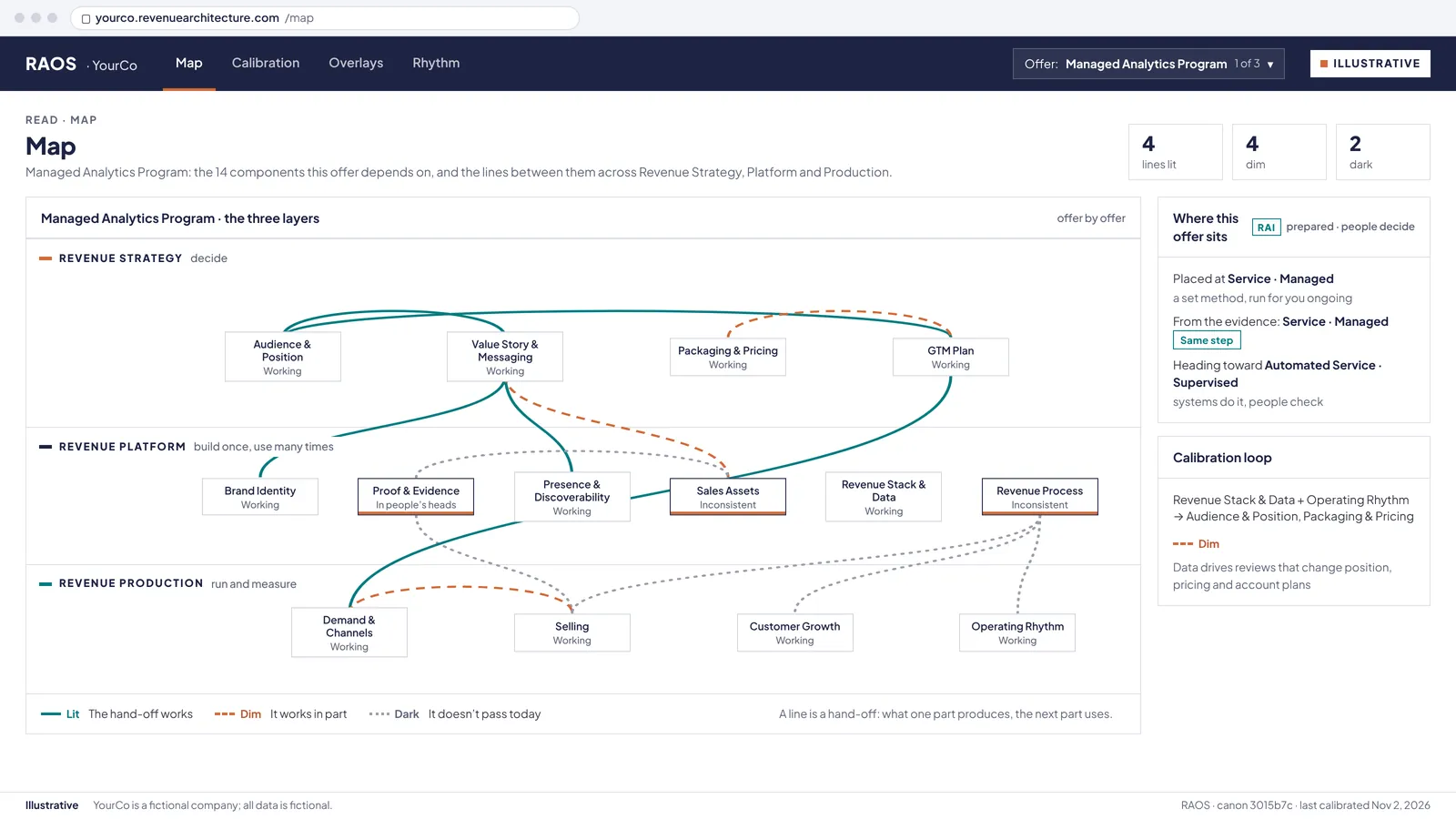
The named hand-offs between components, shown lit, dim or dark: the value story reaching the sales assets, delivery outcomes becoming proof. Dim and dark Connections are what Calibration acts on.
See the Connections →
RAI
Revenue Architecture Intelligence, the intelligence layer.
RAI holds the Record, the system of record for your revenue architecture, keeps the system current between reviews and carries the state of the Connections. Human-orchestrated, AI-enabled: RAI prepares, people decide.
Human and AI roles →Human-orchestrated. AI-enabled.
Where each offer sits
Five positions, set offer by offer
RAOS places each offer by what carries the value the buyer pays for, and who is accountable for it. The position applies to an offer, never to the firm, and it isn’t a ranking: each one needs its own story, proof, selling and price.
- ExpertiseJudgment of named, accountable people, working with agents; the buyer pays for the person’s call.
- ServiceA team’s method, scope set before the sale; the firm is accountable.
- Automated ServiceThe provider’s systems and agents; the provider is accountable at machine volume; people supervise.
- ProductAn asset the buyer uses (physical, software, data); the buyer is accountable for its use.
- NetworkParticipants the provider connects; the provider is accountable for the rules.
Ordered by who does the core work the buyer pays for · not a ranking. The people | system boundary sits between Service and Automated Service.
What revenue runs on
Six build units, twenty-three components
The Model holds the 23 components every company’s revenue runs on, across Strategy, Platform and Production. RAOS groups them into six build units: the components that are built and changed together. The offer sits at the center, tagged with its Continuum position.
Value to MarketWho the offer is for, why it wins, what the buyer gets and on what terms, and what it delivers.4 components
- Audience & Position Strategy
- Value Story & Messaging Strategy
- Packaging & Pricing Strategy
- Delivery Model Strategy
Market PresenceHow the market sees you and checks you out.4 components
- Brand Identity Platform
- Proof & Evidence Platform
- Presence & Discoverability Platform
- Sales Assets Platform
Route to RevenueWho you reach, how, and the stages that turn interest into agreement.4 components
- GTM Plan Strategy
- Demand & Channels Production
- Selling Production
- Revenue Process Platform
Example offer
Advisory retainer
- Expertise
- Service
- Automated Service
- Product
- Network
Its position on the Continuum sets what “right” looks like for each unit.
Deliver & GrowWhat’s delivered and proven, and how accounts stay and grow.5 components
- Delivery Methods & Tools Platform
- Delivery & Outcomes Production
- Account Growth Plan Strategy
- Customer Programs Platform
- Customer Growth Production
Commercial BackboneTerms, quoting, billing and the systems they live in.3 components
- Offer Catalog & Terms Platform
- Quote-to-Cash Production
- Revenue Stack & Data Platform
Operating CoreWho decides, who does the work, and the rhythm that runs it.3 components
- Governance & Decision Rights Strategy
- Team & Capabilities Platform
- Operating Rhythm Production
Where components hand off
Lit, dim or dark
Connections are the named hand-offs between components. RAOS shows each one as lit, dim or dark, offer by offer, and RAI carries their state between reviews.
Lit the hand-off holdsDim it holds in partDark it doesn’t hold
- Value story Sales assets Lit
- Target buyers Go-to-market plan Lit
- Package and price Quoting and billing Dim
- Qualified interest The right seller Dim
- Delivery outcomes Proof Dark
RAI · The intelligence layer of RAOS
RAOS keeps a Record of your revenue architecture, offer by offer, and RAI keeps it current.
RAOS is a solution, not software: practitioners plus RAI, offer by offer. RAOS keeps the Record, RAI keeps it current, and people make the calls.
Today our team runs RAI as a practitioner-run system: tools, AI and your Record, operated by people who make the calls. Here’s what’s in use now and what’s on the roadmap.
| Part | What it does | Status |
|---|---|---|
| The Record | Keeps your revenue architecture, client by client: your offers and where each sits on the Continuum, the components each depends on, which Connections are lit, dim or dark, and every Calibration note and decision. Yours to export. | In use, kept by our team |
| Rules that decide | Calibrated standards that read the evidence the same way every time, so a call is never just an opinion. | In use in the Diagnostic and our reviews |
| AI that reasons | Reads what changed, drafts the groundwork and prepares each review. Ours today; your own AI assistant later. | In use (ours, run by our team) · Roadmap (your own AI assistant, after an independent security review) |
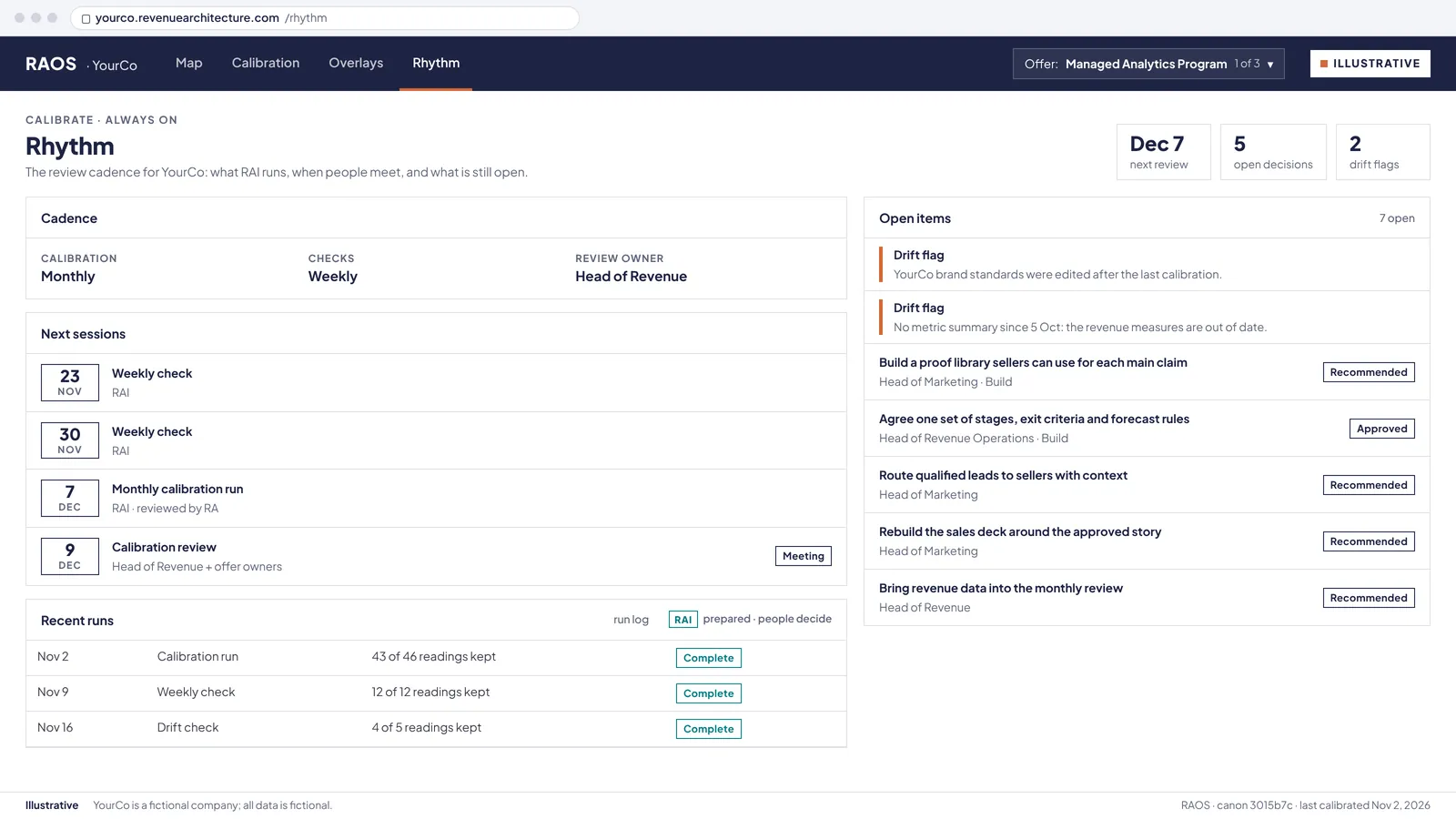
| Rhythm | Scheduled checks on each offer’s cadence: quarterly as the standard, monthly while an offer is shifting, plus a review when drift shows. | In use, run by our team · automated checks on the roadmap |
| Your page at yourco.revenuearchitecture.com | One screen per company: what’s dark, the call each offer needs, what changed since the last review. | Roadmap (a demo with a fictional company comes first) |
| Summaries from your systems | Summaries from your CRM and analytics feed the Record. Summaries only, never raw records. | Roadmap |
We don’t put personal data into AI tools. Your Record holds roles, not names.
These screens are illustrative, shown with a fictional company.
The vision
Where this is going
As agents take on more of your revenue work, RAOS is where you decide what each motion should be, offer by offer. Offers will be sold by people, by agents, or both. Someone still has to decide what they sell, to whom, at what price, and whether the hand-offs hold.
Revenue Architecture is an open discipline, developed and practiced since 2004 and defined at revenuearchitecture.com. The book is being published in 2027, and anyone can adopt it. It complements other frameworks: recurring-revenue models, product-led growth, sales methodologies and pricing methods are each the right design for some offers.
Start a conversation
Three ways to start
Map your offers
See where each offer stands and what it needs. Free, 10–20 minutes.
Build a component
Pick the build unit that needs work, and the component if you know it.