
Solution
RAOS: your revenue operating system
Revenue Architecture connects strategy, platform and production across every offer. RAOS is the system it runs on, and how it stays current. It sits above the tools you already use.
RAOS isn’t software. It’s the architecture, the method and the intelligence that keep it current.
RAOS
A closed-loop revenue system
Five parts: Continuum · Model · Connections · Calibration · Intelligence.
-
Continuum
Where each offer sits.
Each offer is placed by what carries the value the buyer pays for: Expertise, Service, Automated Service, Product or Network. Offer by offer, never the firm; not a ranking.
The five positions → -
Model
What revenue runs on.
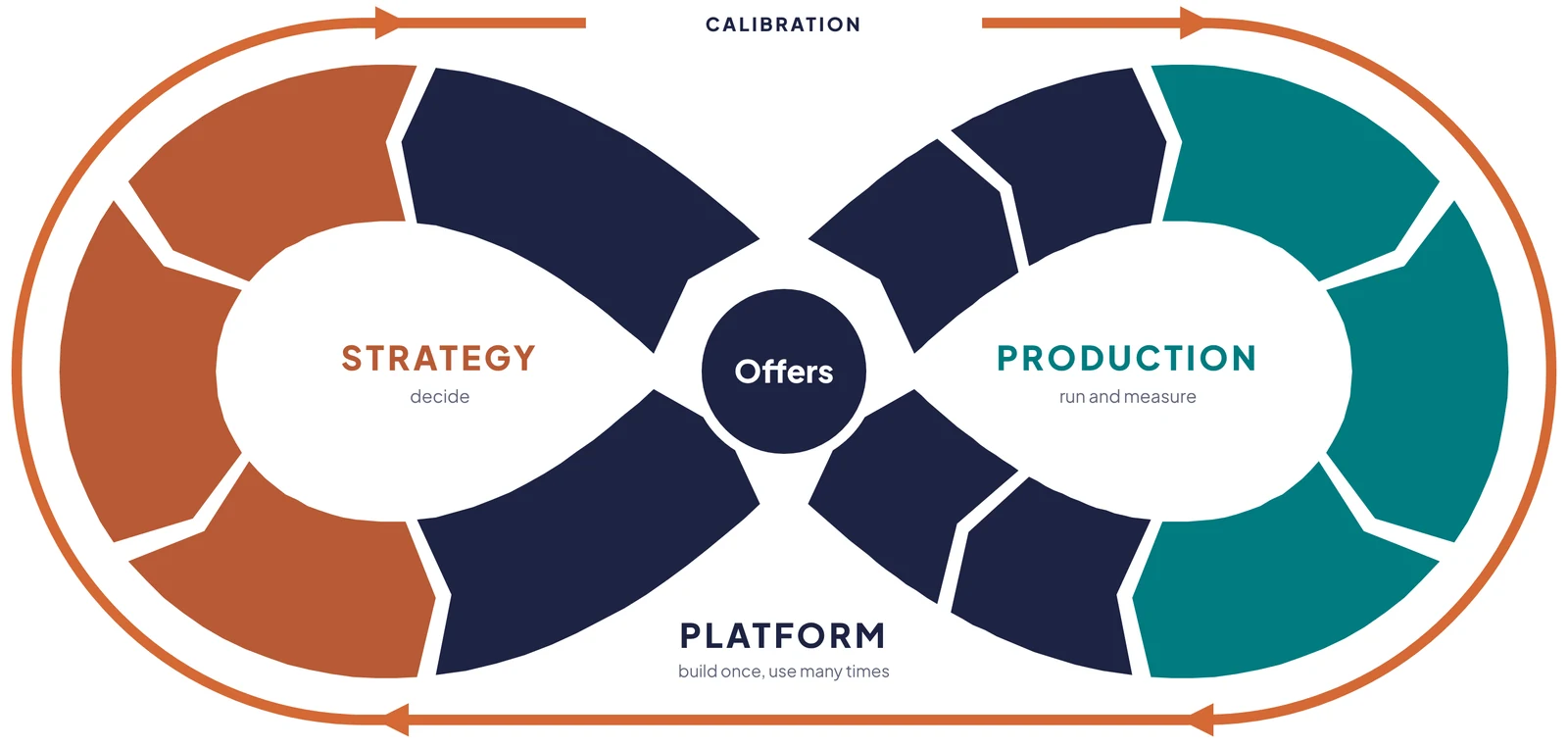
Twenty-three components across Strategy, Platform and Production, in six build units. Each offer sits at the center, tagged with its Continuum position.
See the Model → -
Connections
Where components hand off.
The named hand-offs between components, shown lit, dim or dark: the value story reaching the sales assets, outcomes becoming proof. Calibration acts on the dim and dark ones.
See the Connections → -
Calibration
How it stays right.
The loop around the Model. Each review tests an offer against its position and the evidence, and ends in a decision: shift, tune or no change needed.
How Calibration works → -
Intelligence
Runs across all four.
Whatever AI does the groundwork: it holds the Record, keeps the system current between reviews and carries the state of the Connections.
How we run it →
Human-orchestrated. AI-enabled.
The Continuum
Where each offer sits
Five positions, set offer by offer
RAOS places each offer by what carries the value the buyer pays for, and who is accountable for it. It isn’t a ranking: each position needs its own story, proof, selling and price.
- ExpertiseJudgment of named, accountable people, working with agents; the buyer pays for the person’s call.
- ServiceA team’s method, scope set before the sale; the firm is accountable.
- Automated ServiceThe provider’s systems and agents; the provider is accountable at machine volume; people supervise.
- ProductAn asset the buyer uses (physical, software, data); the buyer is accountable for its use.
- NetworkParticipants the provider connects; the provider is accountable for the rules.
Ordered by who does the core work the buyer pays for · not a ranking. The people | system boundary sits between Service and Automated Service.
Model
What revenue runs on
Six build units. 23 components. One connected revenue architecture.
The Model holds the 23 components every company’s revenue runs on, across Strategy, Platform and Production. RAOS groups them into six build units: the components that are built and changed together. The offer sits at the center, tagged with its Continuum position.
Value to MarketWho the offer is for, why it wins, what the buyer gets and on what terms, and what it delivers.4 components
- Audience & Position Strategy
- Value Story & Messaging Strategy
- Packaging & Pricing Strategy
- Delivery Model Strategy
Market PresenceHow the market sees you and checks you out.4 components
- Brand Identity Platform
- Proof & Evidence Platform
- Presence & Discoverability Platform
- Sales Assets Platform
Route to RevenueWho you reach, how, and the stages that turn interest into agreement.4 components
- GTM Plan Strategy
- Demand & Channels Production
- Selling Production
- Revenue Process Platform
Example offer
Advisory retainer
- Expertise
- Service
- Automated Service
- Product
- Network
Its position on the Continuum sets what “right” looks like for each unit.
Deliver & GrowWhat’s delivered and proven, and how accounts stay and grow.5 components
- Delivery Methods & Tools Platform
- Delivery & Outcomes Production
- Account Growth Plan Strategy
- Customer Programs Platform
- Customer Growth Production
Commercial BackboneTerms, quoting, billing and the systems they live in.3 components
- Offer Catalog & Terms Platform
- Quote-to-Cash Production
- Revenue Stack & Data Platform
Operating CoreWho decides, who does the work, and the rhythm that runs it.3 components
- Governance & Decision Rights Strategy
- Team & Capabilities Platform
- Operating Rhythm Production
Connections
Where components hand off
Lit, dim or dark
Connections are the named hand-offs between components. RAOS shows each one as lit, dim or dark, for each offer.
Lit the hand-off holdsDim it holds in partDark it doesn’t hold
- Value story Sales assets Lit
- Target buyers Go-to-market plan Lit
- Package and price Quoting and billing Dim
- Qualified interest The right seller Dim
- Delivery outcomes Proof Dark
Calibration
How it stays right
Offer by offer, on each offer’s cadence
Calibration reads each offer on two bases: its components (which are in place and working, and the Connections between them, lit, dim or dark) and its Continuum position. It tests the offer’s architecture against where it sits and against the evidence, and ends in a decision: shift, tune or no change needed.
Calibration is the path around the Model. The cadence is set per offer: quarterly as the standard, more often while an offer is shifting. Between reviews, a live question is answered as a Calibration note and logged in the Record.
Intelligence
Revenue Architects Intelligence (RAI) keeps the current record of your revenue architecture, offer by offer.
RAI is the toolset we use to run RAOS. It drafts the prep for each review, keeps the Record current, flags drift, and maintains your Atlas, a map for each offer, so every review starts from evidence.
| Part | What it does |
|---|---|
| Record | Keeps your revenue architecture: your offers and where each sits on the Continuum, the components each depends on, which Connections are lit, dim or dark, and every Calibration note and decision. Yours to export. |
| Rules | Calibrated standards that read the evidence the same way every time, so a decision is never just an opinion. |
| AI | Reads what changed and drafts the groundwork and the prep for each review. |
| Rhythm | Scheduled checks on each offer’s cadence: quarterly as the standard, more frequent while an offer is shifting. |
| Atlas | Your Atlas at yourco.revenuearchitecture.com: each offer’s Map, Connections and Calibration, plus the Record of what changed, updated after each session. |
| Integrations | Summaries from your CRM and analytics can feed the Record. |
We don’t put personal data into AI tools. Your Record holds roles, not names.
A sample Atlas, with a fictional company and data.
Vision
Where this is going
As agents take on more of your revenue work, RAOS is where you decide what each motion should be, offer by offer. Offers will be sold by people, by agents, or both. Someone still has to decide what they sell, to whom, at what price, and whether the hand-offs hold.
Revenue Architecture is an open discipline, developed and practiced since 2004 and defined at revenuearchitecture.com. The book is being published in 2027, and anyone can adopt it. It complements other frameworks: recurring-revenue models, product-led growth, sales methodologies and pricing methods are each the right design for some offers.
Ways in
Four ways in. Each one is a start.
Start free with the Diagnostic, then pick the one that fits. Whichever you choose, Calibration builds over time, offer by offer.
Start free: the Diagnostic
About 10–20 minutes online. You get a readout of where each offer sits and what it needs, then a free conversation about what to do next.
-
Offer Calibration
$5,000 · one offer
The first cycle of Strategic Calibration: we place the offer on the Continuum, check its Connections, find the build-unit gaps, set up its first Atlas, and recommend the cadence and program scope.
Starts from your Diagnostic.
A start: Calibration builds from here, offer by offer.
-
Start with a question
Bring one live question. It’s answered as a Calibration note, and your Record starts there.
A start: Calibration builds over time, one question and one offer at a time.
-
Build Now
Start on an urgent component. The sprint work begins building your Calibration layer.
A start: each build is connected, and Calibration builds around it over time.
The program. Strategic Calibration then runs as a program retainer, priced from your Offer Calibration. Each sprint is scoped and priced before it starts. Or start a conversation →