
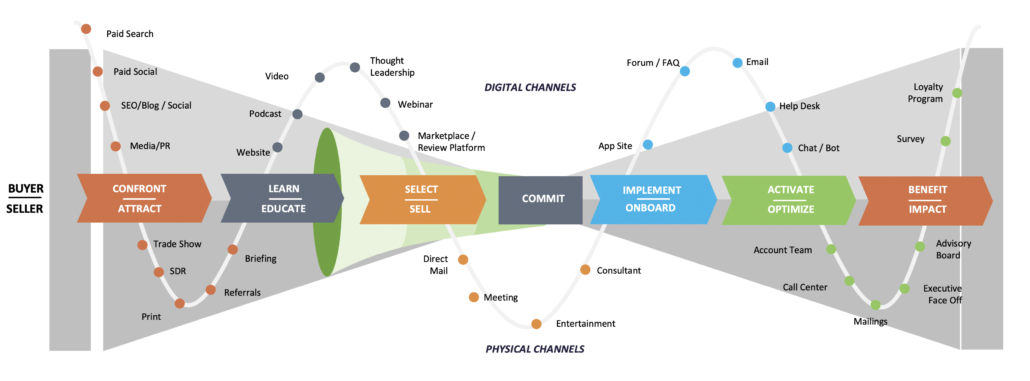
The Bow Tie Funnel: Architecting for Full-Funnel Revenue Realization
Traditional sales funnels treat the “close” as the finish line. In a modern Revenue Architecture, it’s only the midpoint.
Predictable, sustainable, and accelerated performance relies on a Full-Funnel Approach. This requires shifting from the vertical funnel of the 1990s to a Bow Tie Funnel—a model that integrates marketing, sales, and customer execution to focus on the entire customer lifecycle.
The Buyer’s Reality: Unstructured and Digital-First
Today’s buyers are self-directed. They don’t care if a touchpoint is “marketing” or “sales”—they care about the experience. According to Google, 71% of B2B researchers start with a generic search, and DemandGen reports that a company’s website is often the most influential touchpoint in the decision process.
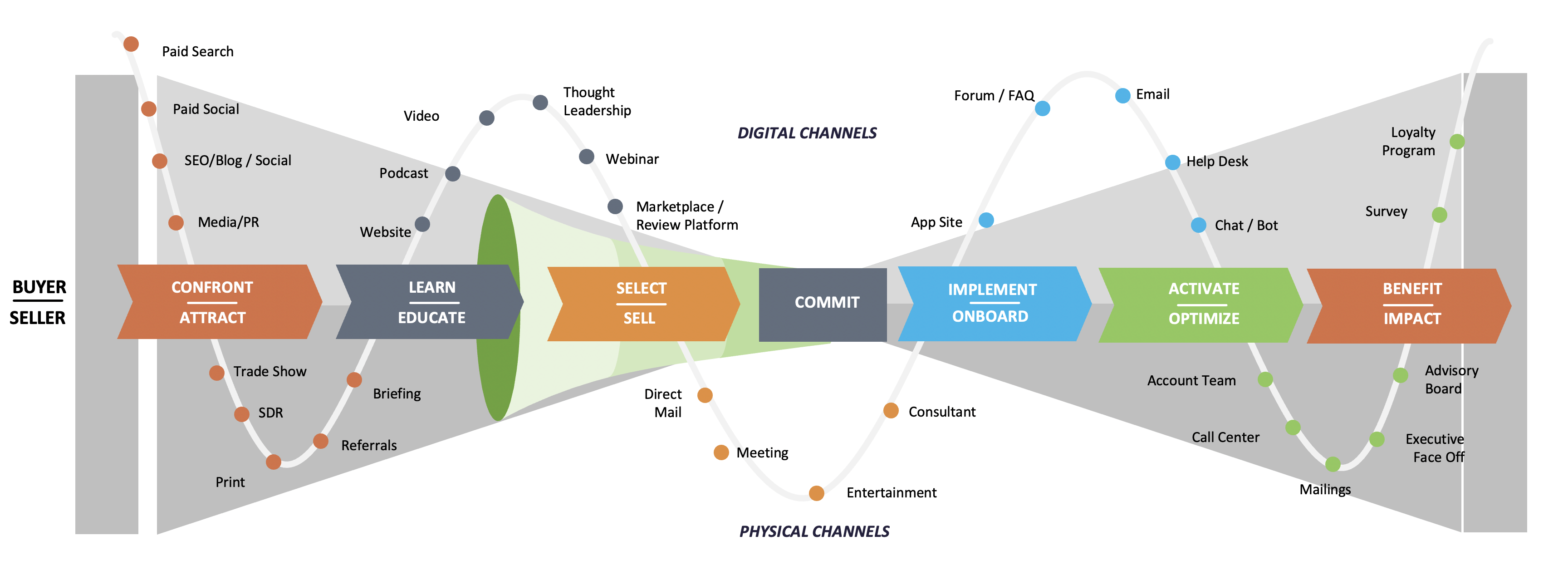 |
To meet this buyer, your process must mirror their journey. We break the Bow Tie down into specific Buyer-Seller stages:
The Left Side: Acquisition & Engagement
- Confront & Attract: The buyer confronts a problem; the seller attracts them with helpful, insight-led content.
- Learn & Educate: The buyer enters “learning mode.” We use Equitable Exchange principles to provide value while qualifying mutual fit.
- Select & Engage: The buyer narrows their choice. Sales orchestrates deep interactions combined with ongoing digital self-sell resources.
The Knot: The Commitment
- Commit & Close: This is the moment of mutual commitment. In a Bow Tie model, this is where the “real” work of revenue realization begins.
The Right Side: Retention & Expansion
- Activate & Deliver: Onboarding is critical. Successful training and usage are the precursors to recurring revenue.
- Benefit & Impact: Revenue is only secure when the buyer realizes the benefits they expected. Our role is to Impact their success to earn the right to upsell and cross-sell.
Tailoring the Process: Structured vs. Unstructured
Not every funnel is the same. Your process must be tailored to your position on the Business Architecture Continuum (BAC):
- Structured Processes: Ideal for high-volume, lower-dollar transactions where routine activities (scripted calls, demos) drive efficiency.
- Stage-Based (Unstructured) Processes: Essential for complex, high-value advisory or enterprise sales. Here, stages define qualification status rather than specific tasks, allowing for the orchestration of a complex buying lifecycle.
Architect’s Note: If you are still managing your business with a vertical funnel, you are only seeing half the picture. The Bow Tie ensures that your “customer execution” is just as strategic as your “sales execution.”

